Skip to content
minShelfminShelf.com
GroupsFeedHomeAI-dentifyFeedback
Smithsonite - minShelf
Smithsonite
J
@jcg

Jcg·18 Jun 2026

Smithsonite

AI-suggested ID

Amazonas, Peru

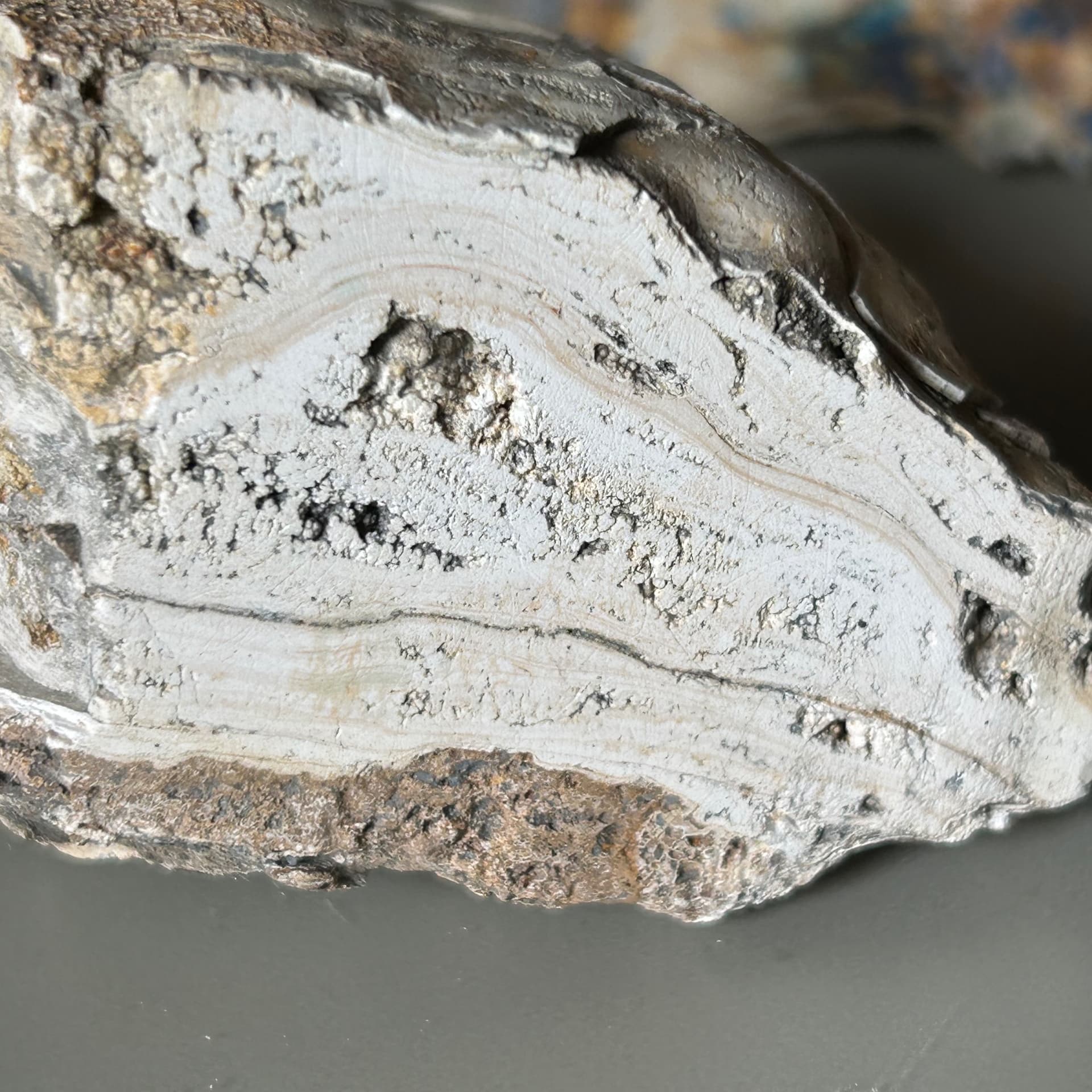
The Bongará (MTV) deposit is renowned for its exceptional banded/laminated smithsonite. The concentric pale grey layering with botryoidal crust is highly characteristic. Effervescence in dilute HCl and high SG (~4.4) will confirm. Coloured varieties (blue-green, pink) occur at this locality too.

ZnCO₃crystal

Mineral Properties

Hardness

4-4.5

Luster

Pearly

Streak

white

Crystal System

Trigonal

Cleavage

Perfect rhombohedral {10-14}

Fracture

Uneven to subconchoidal

Transparency

Translucent to opaque

Formation

Supergene oxidation of primary sphalerite (ZnS) in carbonate-hosted Zn-Pb deposits. Zinc-bearing fluids react with carbonate host rock, precipitating colloform-banded smithsonite in vugs and replacement zones.

Geological origin

Bongará District, Amazonas, Peru

Properties

color

pale grey-white banded with botryoidal crust

Where else to find

Kelly Mine, Socorro County, New Mexico, USATsumeb Mine, NamibiaLaurion, Attica, GreeceBroken Hill, New South Wales, AustraliaMapimí, Durango, MexicoSardinia, Italy

Suggested tests

  • • Apply dilute HCl — smithsonite will effervesce (COâ‚‚ bubbles), confirming carbonate identity
  • • Test specific gravity: smithsonite is notably heavy (~4.4 g/cm³), much denser than calcite or hemimorphite
  • • Check with shortwave UV lamp — hydrozincite (a common look-alike) fluoresces bright blue-white; smithsonite is typically inert or weakly fluorescent
  • • Scratch test with a steel knife (~5.5 Mohs): smithsonite at 4–4.5 will be easily scratched, ruling out harder silicates

Could also be

Hemimorphite - Also a zinc carbonate-zone mineral with pale grey-white banded botryoidal habits; distinguished by lower SG (~3.4 vs 4.4), different crystal form, and HCl reaction (no effervescence in hemimorphite)
Cerussite - Lead carbonate can show similar pale grey laminated botryoidal masses in oxidised base-metal deposits; distinguished by much higher SG (~6.5), adamantine lustre, and distinct effervescence in HCl
Hydrozincite - Common zinc oxidation mineral with similar pale white-grey earthy masses; distinguished by strong bright-blue UV fluorescence, lower SG (~3.6), and powdery texture
primary-ore-zinc-metcollector-mineral-lahistorical-pigment-szinc-supplementation
0

Comments (0)